Online Talk Explores Laudato Sí and Sustainability
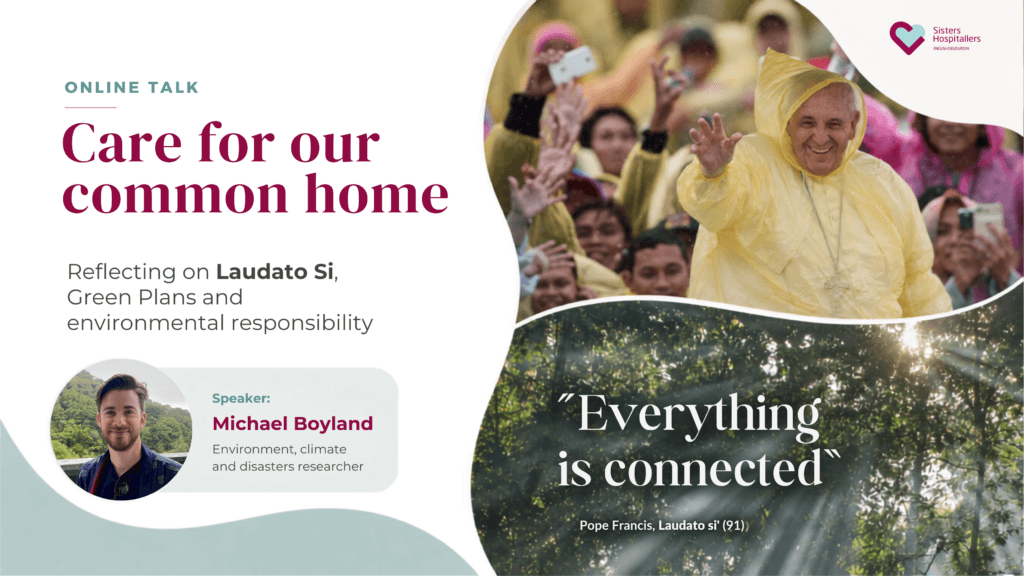
Michael Boyland reflected on Laudato Si’, Green Plans and the growing role of environmental responsibility in health care
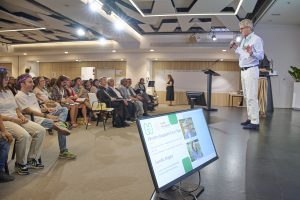
An online talk held on 11 June invited participants from across the Delegation of England to reflect on the connection between environmental sustainability, health and social care.
The session, titled “Care for our common home: Addressing climate change and environmental sustainability in health and social care”, was led by Michael Boyland, an environment, climate and disasters researcher. Michael has worked in Asia for over a decade and is currently writing his PhD while teaching in Development Studies at the School of Oriental and African Studies (SOAS) in London. His work focuses on how different groups experience and respond to environmental change, especially young people.
The talk provided an overview of how environmental challenges are increasingly linked to care delivery and the wellbeing of the people and communities served by health and social care organisations.
It also explored the legacy of Laudato Si’, Pope Francis’ encyclical on care for creation, and introduced the Laudato Si’ Action Platform as a practical framework for Catholic organisations seeking to develop a Laudato Si’ Plan, identify effective actions and track progress.
Michael also addressed the role of environmental sustainability within health and social care, including how CQC considers this area within its assessment framework. The session highlighted the importance of understanding environmental impact, developing Green Plans, encouraging shared goals around low-carbon care and embedding net zero principles into planning and delivery.
A significant part of the talk focused on practical areas to consider when developing a Green Plan. These included travel and transport, estates and facilities, medicines and supplies, food, waste management, energy usage and efficiency, green spaces, finance and education.
The session also presented some of the challenges organisations may face when moving forward. These included the broad impact of climate and environmental issues across many aspects of care delivery, the lack of baseline data on carbon footprint, limited guidance for care settings and the fact that some measures may not deliver an immediate return on investment.
At the same time, the talk highlighted important opportunities: becoming a sector and community leader in environmentally friendly care, drawing on networks and resources from the Church, government, businesses and local communities, connecting centres with the wider Sisters Hospitallers global community, and implementing a Laudato Si’ Plan that can complement a Green Plan.
The session concluded with an open discussion, giving participants the opportunity to reflect on how these themes relate to the reality of our own centres. The exchange helped bring the topic closer to everyday practice and encouraged reflection on how environmental sustainability can be approached in a way that is realistic, meaningful and adapted to different contexts.
For Sisters Hospitallers, this reflection is especially relevant. Our centres work in very different realities, from care homes in England to health and social care projects in Africa. Each context has its own needs and possibilities, but all are united by the same commitment to dignity, wellbeing and responsible care.
The talk offered an important opportunity to reflect on how care for people and care for our common home can come together within the Hospitaller mission, encouraging practical reflection on the steps that may be taken in the future.
We thank Michael Boyland for sharing his knowledge and experience, and for guiding this timely conversation on environmental responsibility in health and social care.